
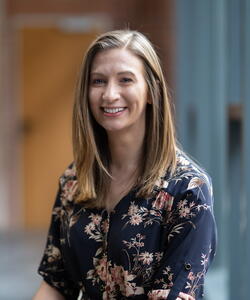
Professor Amanda Young has been named as a 2026-27 Center for Advanced Study (CAS) Fellow. She is among six assistant professors who have been selected across campus for this competitive and prestigious opportunity. This program grants one semester of teaching release to participate in an individual scholarly or creative project, which Young will use to attend the Fall 2026 thematic program “Mathematics of Many-Body Entanglement” (MMBE) at the Isaac Newton Institute in Cambridge.
Since completing her PhD at UC Davis in 2016, Professor Young spent three years as a Postdoctoral Research Associate at the University of Arizona, before taking a position as a Distinguished Postdoctoral Scholar at the Technical University of Munich and the Munich Center for Quantum Science. She joined the Department of Mathematics in 2023 and is also a member of the Illinois Quantum Information Science and Technology Center (IQUIST), an interdisciplinary team of researchers at Illinois who work collaboratively on the growing field of quantum information science.
Young’s research is primarily centered around the classification of quantum phases of matter. At extremely low temperatures, the typical interactions between molecules that define characteristics of classic states of matter (solid, liquid, gas, etc.) are suppressed allowing for quantum mechanical effects to dominate. As a consequence, exotic quantum phases of matter emerge that present exciting opportunities for developing novel devices for computation. While progress has been made toward classifying these quantum phases of matter, the field is still rife with questions left to solve. In recent years, Young has made significant progress towards two long-standing conjectures in the field, work for which she earned an Early Career Scientist Prize in 2024 from the International Union of Pure and Applied Physics (IUPAP).
A key phenomenon in quantum states is that they can be entangled, and the main aim of the MMBE program is to study the complexity, structure and dynamics of entangled states. A key component to defining and distinguishing quantum states of matter is understanding this underlying entanglement structure, how this entanglement manifests, and at what distances this entanglement occurs. Part of what makes this topic so complex is that advances require a high level of collaboration among scientists from different subfields with distinct expertise. One of the main goals of the MMBE programs is to bring together researchers with a broad range of specialties to learn from one another and pursue cutting edge research related to the entanglement in quantum states. In addition to these new research directions, Professor Young will also have the opportunity to meet with several collaborators, driving forward multiple research projects. This includes a series of projects related to analytical proofs of spectral gaps in models conjectured to be typical of gapped ground state phases of matter.