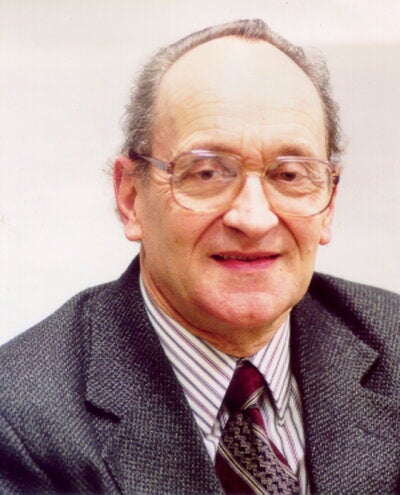
The Tondeur Lectures in Mathematics was created by the Department of Mathematics in 2012, named in honor of Professor Emeritus Philippe Tondeur to recognize his contributions to the mathematics community. This biannual series is offered in alternate years with the Coble Lectures. The lecture series is supported by an endowment funded by Philippe and Claire-Lise Tondeur.
Title
Recent Lectures in This Series
December 5–7, 2023: Noga Alon, Princeton University
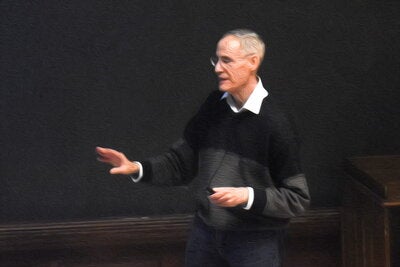
In a series of three lectures, we revisited three well-known examples of distance problems in discrete geometry: the Erdős Unit Distance Problem, the Erdős Distinct Distances Problem, and the Hadwiger-Nelson Problem.
Alon discussed recent solutions of the analogs of all three problems, and how combinatorial, geometric, and probabilistic methods can be combined with tools from linear algebra, topology, and algebraic geometry to answer related questions. These talks were based on joint works with Matija Bucić, Lisa Sauermann, Colin Defant, Noah Kravitz, and Daniel Zhu.
Schedule
| Title | Date/Time | Location |
|---|---|---|
| "Unit distances" | Dec. 5 4:00 p.m. |
180 Bevier Hall Reception in Bevier Hall Commons to follow |
| "Distinct distances and equilateral numbers" | Dec. 6 4:00 p.m. |
4025 Campus Instructional Facility Refreshments available beginning at 3:30 p.m. |
| "Coloring and ordering" | Dec. 7 4:00 p.m. |
4025 Campus Instructional Facility Refreshments available beginning at 3:30 p.m. |
About the Speaker

Noga Alon is a professor of mathematics at Princeton University and a Baumritter professor emeritus of mathematics and computer science at Tel Aviv University, Israel. He studies combinatorics and graph theory and their applications in theoretical computer science. Among his contributions are the study of expander graphs, the investigation of de-randomization techniques, and the foundation of streaming algorithms.
Alon is a member of the Israel Academy of Sciences and Humanities and the Academia Europaea; he is an honorary member of the Hungarian Academy of Sciences. He recently received the Shaw Prize in Mathematical Sciences and the Knuth Prize for outstanding contributions to the foundations of computer science.